Who Killed Oskar Fischer and His Science?
Stolen Twice: His Science in 1910, His Sanatorium in 1941, and the Sixty-Three Years That Followed
Abstract
Oskar Fischer built two things. He built a description of a disease — sixteen brains in 1907, some 275 by 1910, with an eight-stage chronology, a three-way nosology, and the first account in the literature of the lesion in cognitively normal brains. And in 1908 he and his cousin Leo Kosák bought an estate at Veleslavín on the western edge of Prague and turned it into a sanatorium for the mentally ill, which they ran for thirty-one years and which the two families would later describe before a court as the existential base of both households.
Both were stolen from him, and neither has been returned to us. In 1910 Emil Kraepelin named the disease after a colleague in his own institute, and within a decade Fischer's framework was out of the literature. In 1941 the Protectorate administration transferred the sanatorium to a man it had just released from prison, and within a year Fischer was dead. The two thefts were not the same kind of act and no causal line runs between them — the first broke no law and had no perpetrator; the second was a crime that ended in a police prison. But in both, the thing was stolen intact and re-attributed to somebody better placed, the instrument was paperwork rather than force, and the record of who made it was allowed to go quiet.
This paper is about the doubling, and about the second theft in particular, which has never been documented. The first is covered in one chapter and treated at length in a companion study.
The sequence is short and it is fully papered. On 15 March 1939 German troops entered Prague. On 17 March — two days later — Fischer went to a notary in Prague-Smíchov and signed his half of the Veleslavín properties over to his wife Františka, who was not Jewish, reserving only a life usufruct. The manoeuvre failed, as it failed for everyone who tried it. On 19 November 1940 part of the estate passed to the Emigration Fund for Bohemia and Moravia, a body created to dispose of Jewish property. On 5 June and 12 August 1941 the remainder passed by purchase contract to Dr. med. Otto Knahl, described in the instruments themselves as a "German of Aryan origin" — a man who had been convicted in 1937 of running for the Dresden station of the Abwehr under the double agent Paul Thümmel, sentenced to fifteen years, and freed from a Czechoslovak prison by the occupation that then handed him a sanatorium.
Fischer was never paid. The purchase price of 1,080,000 crowns was directed into blocked accounts from which, the approving document states, the costs of his transport to and stay in the concentration camp were to be met. A further compensatory levy of over 1.2 million crowns went to the treasury of the Reich Protector. He was made to finance his own imprisonment out of the sale of the institution he had built.
He did not sign willingly. A fellow prisoner, writing to Fischer's son in 1946, records that Fischer told him he had been arrested on the grounds that he had refused to sign the sale of his sanatorium to the Gestapo. He was held at the Small Fortress at Terezín — the Gestapo police prison, not the ghetto — in cells 7 and 6, which we know because he wrote the cell numbers in his own hand on the postcards home. On 23 February 1942 the Senior District Administrator formally approved the "de-Jewification of the sanatorium in Veleslavín." Five days later, on 28 February 1942, Oskar Fischer died of injuries sustained under interrogation. His wife was notified by 3 March.
The remaining three regimes are the part of this history that has never been told. In November 1945 the restored Czechoslovak state placed the sanatorium under National Administration — because on the register it belonged to a German. The heirs filed for restitution in February 1947 and were told that even a successful claim would be followed by a compulsory thirty-year lease; they offered instead to sell the property to the Ministry of Health outright, conditional on the restitution first being granted. In January 1951 the courts closed the proceedings, acknowledging that Fischer had lost the property through racial and political persecution and leaving any compensation to ministerial discretion. On 17 October 1952 the state registered the ownership to itself.
After 1989 Fischer's daughter-in-law, Hana Fischerová, sued to have the 1940 and 1941 contracts declared void. The courts agreed with her about the history and dismissed her anyway. They found the contracts invalid, concluded that Fischer had been martyred through racial persecution, and then held that the claim was time-barred under a three-year post-war window, that a declaration of invalidity would not restore the property and so disclosed no urgent legal interest, and that the Czechoslovak state — which had seized the property in 1952 precisely because it had belonged to a convicted Nazi agent — had acquired good title through ten years' possession in good faith. The appellate court dismissed the family's claim in 2005.
The paper closes by returning to the question in its title. Fischer's science was not killed; it was displaced, lawfully, by a naming that pointed away from the larger series, and it was partly recovered when people went back and read him. His institution was stolen outright, and it has not been recovered at all. The two are joined by pattern rather than by cause — twice a man built something substantial, twice it was lifted whole and given another name, and the second time the theft killed him. What the documents establish, and what needs no help from the pattern to matter: a physician was arrested for refusing to sign away a hospital, was made to pay for his own imprisonment out of the proceeds, died of injuries sustained under interrogation five days after the paperwork cleared, and three states in succession acknowledged all of it and declined to give the building back.
Keywords: Oskar Fischer, Veleslavín, Leo Kosák, Aryanization, Entjudung, Otto Knahl, Paul Thümmel, Abwehr, Emigration Fund for Bohemia and Moravia, Small Fortress, Terezín, Theresienstadt, restitution, Act No. 128/1946 Coll., adverse possession, Holocaust-era property, Czechoslovak nationalisation.
Competing interests. This paper is published by a research programme of which Dr. James Truchard, who endowed the Oskar Fischer Prize, is a co-author; the author is that programme's other principal. Nothing in this paper assesses the prize, and its argument is independent of that relationship. The primary documents reproduced here belong to the Fischer family and are published with the family's permission. The author has no financial interest in any restitution claim, and none is advocated here.
On the limits of this paper. It is not a legal opinion and makes no recommendation about any claim. It is a documentary reconstruction. Where the record is uncertain — and on one central point, the date of the arrest, it is — the uncertainty is reported rather than resolved.
Contents
Front Matter Abstract · Contents · Note on Method and Sources
1. Introduction: A Theft That Happened Twice
Chapter I. The First Theft: A Disease, 1907–1924 1.1 The Larger Series 1.2 The Naming 1.3 What Kind of Theft That Was
Chapter II. The Institution, 1908–1939 2.1 Two Cousins and an Estate 2.2 What the Sanatorium Was to Them 2.3 January 1941: Still Asking Permission to Practise
Chapter III. The Theft, 1939–1942 3.1 The Seventeenth of March 3.2 The Emigration Fund 3.3 Dr. Otto Knahl 3.4 The Blocked Account 3.5 The Refusal 3.6 The Small Fortress 3.7 The Twenty-Third of February 3.8 The Death
Chapter IV. Limbo, 1945–1948 4.1 National Administration 4.2 The 1947 Filing and the Thirty-Year Lease 4.3 What the Families Argued
Chapter V. Nationalisation, 1948–1989 5.1 Law No. 185/48 5.2 January 1951: Persecution Acknowledged, Compensation Discretionary 5.3 17 October 1952
Chapter VI. The Modern Court, 1990s–2005 6.1 Hana Fischerová's Claim 6.2 What the Courts Conceded 6.3 Urgent Legal Interest 6.4 The Three-Year Window 6.5 Good Faith 6.6 The 2005 Dismissal
Chapter VII. What the Record Establishes 7.1 The Question in the Title 7.2 What This Is Not Evidence Of 7.3 What It Is Evidence Of 7.4 The Unresolved Points 7.5 Conclusion: In Good Faith
Documents · References
Note on Method and Sources
This paper rests on a body of primary material held by the Fischer family and published here for the first time, with the family's permission. It comprises: the notary donation contract of 17 March 1939, in the original and in translation; correspondence of the Ministry of Social and Health Administration dated 1 February 1941, in Czech and German; Oskar Fischer's own postcards from the police prison at Theresienstadt; parcel counterfoils stamped at Terezín and an envelope of the Prague State Police headquarters; a letter of 19 December 1946 from Rudolf Beck, a fellow prisoner, to Fischer's son Jindřich; a sworn declaration of 1969; a certificate of the Ministry of National Defence, no. 107559/1969; and translated findings of the Czech district and appellate courts of 2003 and 2005.
Three cautions govern how that material is used.
Transcripts are marked as transcripts. The Beck letter as reproduced here is a typed translation, not a facsimile of the original; the court findings are translations of Czech judgments. Where the argument turns on precise wording, that wording is a translator's, and the paper says so at the point of use rather than in a footnote.
One external claim is carried on a published academic source rather than on the family papers. The identification of Otto Knahl as an Abwehr agent convicted in 1937 comes from Stanislav Kokoška's study of German military counterintelligence in Prague, published in Soudobé dějiny by the Institute of Contemporary History of the Czech Academy of Sciences (Kokoška, 2003, pp. 473–474). It is the one substantial assertion in this paper that a reader can verify without applying to the family, and it is deliberately load-bearing for that reason.
Where the documents disagree, the disagreement is reported. They disagree on one point of consequence — the date of Fischer's arrest — and §3.5 sets out the three dates and declines to choose between them beyond what the evidence supports.
What is still outstanding, and stated so a reader can weigh it. The archival locations of the originals, and the case numbers of the 2003 and 2005 judgments, are not given here. They exist; they were not available to this paper at the time of writing. A reader who requires them should ask, and any subsequent edition should carry them. This paper prefers to say what it does not have rather than to imply a completeness it has not reached.
1. Introduction: A Theft That Happened Twice
Oskar Fischer built two things in his life. He built a description of a disease, across sixteen brains in 1907 and some two hundred and seventy-five by 1910, more comprehensive than any then in existence. And he built a hospital, at Veleslavín on the western edge of Prague, which he and his cousin ran for thirty-one years.
Both were stolen from him. Neither has been returned to us.
That doubling is the subject of this paper, and it is worth being exact about what is being claimed by it, because the claim is easy to overstate and easy to dismiss.
The two thefts were not the same kind of act, and no causal line runs between them. Nobody in Munich had anything to do with what happened at Veleslavín. The men who stole the disease had no idea the sanatorium existed; the man who stole the sanatorium had no interest in the plaque. The first theft broke no law and required no villain. The second was a crime that ended in a police prison.
But they were not unrelated either, and the relation is not a coincidence. In 1910 Emil Kraepelin gave a disease Fischer had described the name of a colleague in his own institute, and within a decade Fischer's framework had gone out of the literature. In 1941 the Protectorate administration gave a hospital Fischer had built to a man it had just released from prison, and within a year Fischer was dead. In both cases the thing was stolen intact — nobody destroyed the staging or demolished the sanatorium — and re-attributed to somebody better placed. In both cases the record of who made it was allowed to go quiet. And in both cases the theft was completed not by force but by paperwork: a textbook entry, and a purchase contract.
What makes that worth a paper rather than an observation is the second half of each story. Fischer's science was recovered, slowly and partially, by people who went back to the 1907 monograph and read it. His sanatorium was not recovered at all, and the reason it was not is the part of this history nobody has written: three successive states looked at the documents, agreed in terms that he had been robbed, and each declined to reverse it.
A note on the balance of this paper. The first theft is covered in one short chapter, not because it matters less but because it is the subject of a companion study which treats it at length. The second occupies the rest, because it has never been treated at all, and because it is documented to a degree the first is not: there is a contract for every transfer, an approval for the expropriation, an instruction directing the purchase price into an account from which the victim's own imprisonment would be paid, letters from the prison in his own handwriting, an eyewitness to the conditions, a death, and then sixty-three years of litigation.
The chapters run in order. Chapter I is the first theft. Chapter II establishes what the sanatorium was and what it meant to the two families who built it. Chapter III documents the second theft and the death, transaction by transaction. Chapters IV through VI follow the property through the three regimes that came after. Chapter VII returns to the question in the title and answers it in the terms this introduction has set.
Chapter I. The First Theft: A Disease, 1907–1924
1.1 The Larger Series
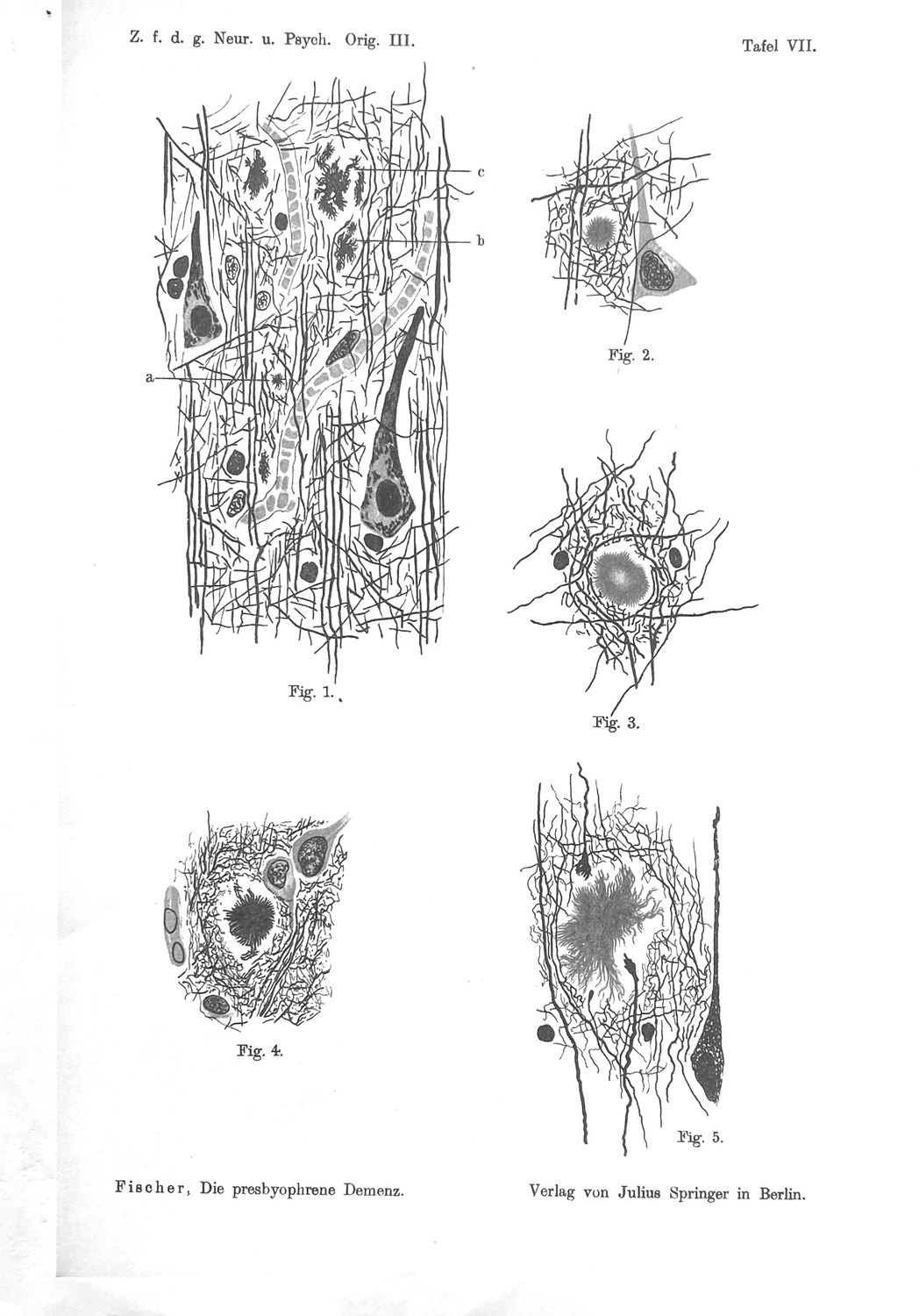
In June 1907, seven months after Alois Alzheimer presented a single case at Tübingen, Oskar Fischer published in the Monatsschrift für Psychiatrie und Neurologie a study of sixteen brains of senile dementia, twelve of them carrying the lesion, and gave the first description of what is now called the neuritic plaque. By 1910 he had drawn on some 275 brains, found the lesion in fifty-six cases, proposed an eight-stage chronology of its evolution keyed to thirteen plates, distinguished three clinically separable forms of senile dementia, and identified the lesion in the brains of the cognitively normal aged — which is, in the published literature, the first description of what the modern field calls preclinical disease.
None of that is in dispute, and none of it is claimed here as a priority argument.
1.2 The Naming
In 1910 Emil Kraepelin, director of the Royal Psychiatric Clinic in Munich where Alzheimer had worked since 1903, named the entity after his colleague in the eighth edition of his Lehrbuch der Psychiatrie.
Goedert (2009) is careful about the motive and this paper follows him: "it is not entirely clear what compelled Kraepelin to separate this condition from senile dementia and to name it after Alzheimer," though Kraepelin gave his own reasons — the young age of the patients, language disturbances, focal signs, severe dementia. What can be said without inference is institutional rather than psychological. Alzheimer was Kraepelin's colleague and appointee. The material had been examined in Kraepelin's clinic. The textbook was Kraepelin's, and it was the standard reference in German-speaking medicine.
Within a decade Fischer's staging was out of the literature. The name he had proposed for the lesion disappeared entirely. By 1930 he was rarely cited in German-language reviews of the disease.
1.3 What Kind of Theft That Was
It is important to be precise here, because the word this paper uses for the second event does not transfer cleanly to the first.
Nothing illegal occurred. Kraepelin was entitled to name what he liked in his own textbook, and textbook editors have always favoured the work they know. There was no theft in any sense a court would recognise, no victim in the sense the later chapters will use the word, and no evidence that anyone intended Fischer harm. He remained in post, published for another fifteen years, and was promoted twice.
What was stolen was attribution, and with it the framework. The disease acquired a name that pointed away from the larger series, and the explanatory vocabulary that came with the eponym — a deposit, a late-stage cortical lesion, a single entity — displaced the one Fischer had built, which had described a staged, morphogenetically active process with a preclinical phase and three separable forms. The field did not reject his framework. It stopped being able to see it, because it was trained inside another one.
That is a real loss and it needs no exaggeration to be one. It is also, and this is the distinction the rest of the paper depends on, a loss without a perpetrator. Chapter VII returns to it.
Chapter II. The Institution, 1908–1939
2.1 Two Cousins and an Estate
In 1908 Oskar Fischer was thirty-two, a year past the publication of Miliare Nekrosen, and an assistant in Arnold Pick's department at the German University in Prague. He would be promoted to Assistant Professor of Psychiatry in 1907 and to Associate Professor in 1917, and he would leave his research position in 1919. On any account of his life written from the university's records, the 1920s and 1930s are a slow fade.
They were not. In 1908 Fischer and his cousin Dr. Leo Kosák bought an estate at Veleslavín, on the western edge of Prague, and converted it into a sanatorium for the mentally ill. They ran it together until 1939 — thirty-one years, longer than Fischer spent at the university, and for the last twenty of them it was his principal professional base.
This is not a footnote to the biography. It relocates it. The standard account of Fischer's interwar years describes a man being marginalised inside somebody else's institution; the correction is that he had his own.
2.2 What the Sanatorium Was to Them
The clearest statement of what Veleslavín meant to the two families comes, as such statements often do, from a legal filing made when it was already lost. In 1947, arguing against a compulsory lease, the heirs described the sanatorium as having been founded on the premise that its founders and their families would themselves practise in it — the "existential base" of both households. They put the point in terms of a thirty-year gap: locked out of the enterprise for three decades, they said, they would lose not only the income but the connection to what they had built, and by the end of the lease there would be no practical way to take it up again.
That is a description of a family business, and it is also a description of a medical institution built by two physicians for the purpose of practising medicine in it. Both halves matter for what follows. The Nazi administration valued the property at over a million crowns. The families valued it as the thing they did.
2.3 January 1941: Still Asking Permission to Practise
The sanatorium was not a dormant asset by 1939, and Fischer was not a retired man. The family papers include correspondence of the Ministry of Social and Health Administration dated 1 February 1941, in Czech and in German, addressed to prof. MUDr. Oskar Fischer at Prague XII, Španělská 4, responding to an enquiry he had made on 27 January 1941 about his authorisation to practise at the Veleslavín sanatorium.
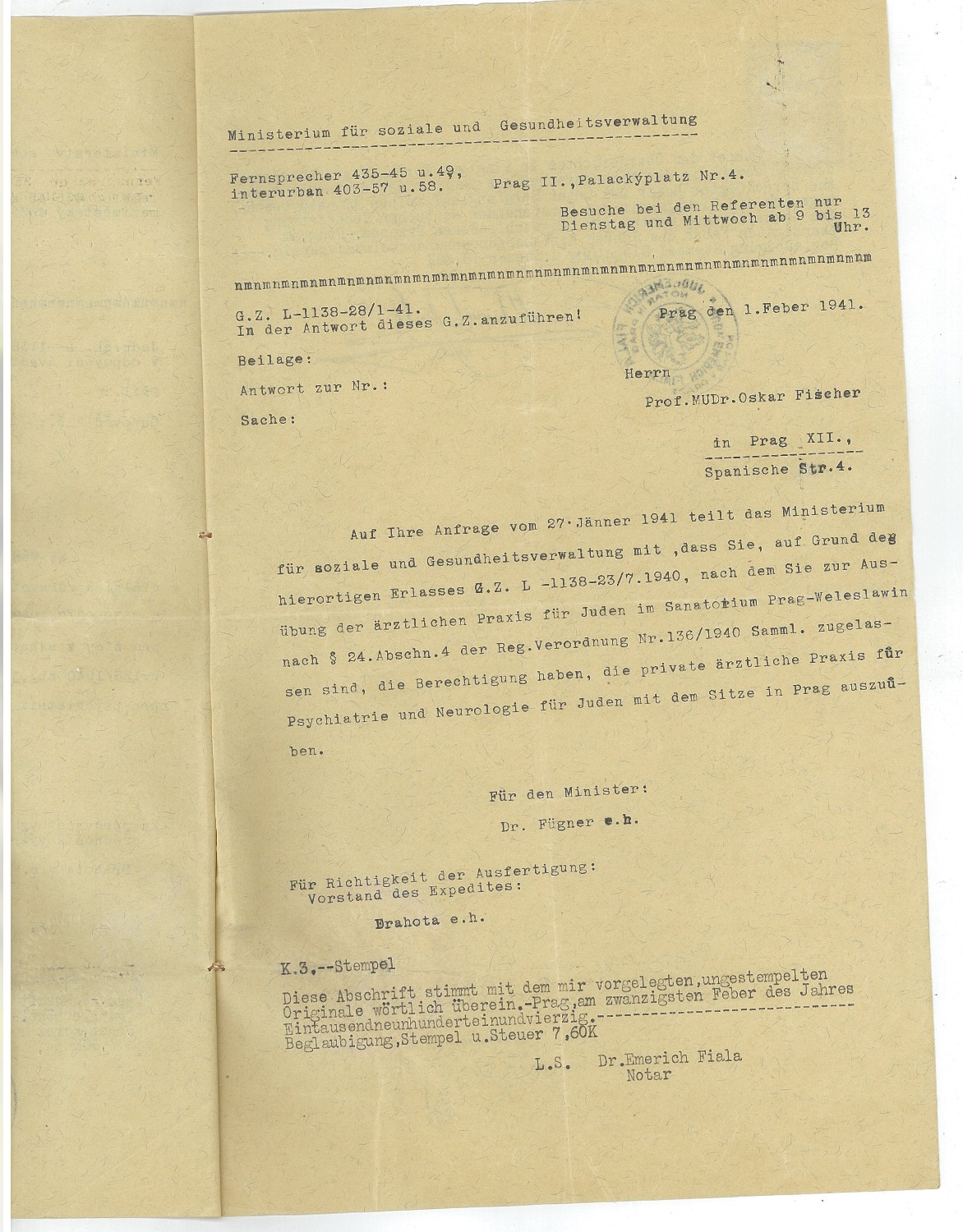
Read forward from 1908, this is an ordinary administrative letter. Read backward from 1942, it is a man who has already lost his university position and is about to lose his hospital, still filing the paperwork required to see patients in it. Whatever else the last year of his working life was, it was not passive.
Chapter III. The Theft, 1939–1942
3.1 The Seventeenth of March
Germany occupied the remaining Czech lands on 15 March 1939, ending Czechoslovak independence and establishing the Protectorate of Bohemia and Moravia. This followed the annexation of the Sudetenland in October 1938 under the Munich Agreement.
Two days later, on 17 March 1939, Fischer went to a notary in Prague-Smíchov and executed a deed of donation transferring his half of the Veleslavín real estate — building plots, gardens and pasture, registered under land registers 108, 147, 148 and 170 — to his wife, Františka Fischerová, who was not Jewish. He reserved to himself the right of usufruct: the right to use the property and take its income, for the remainder of his life. The contract was registered for fee assessment on 18 March.
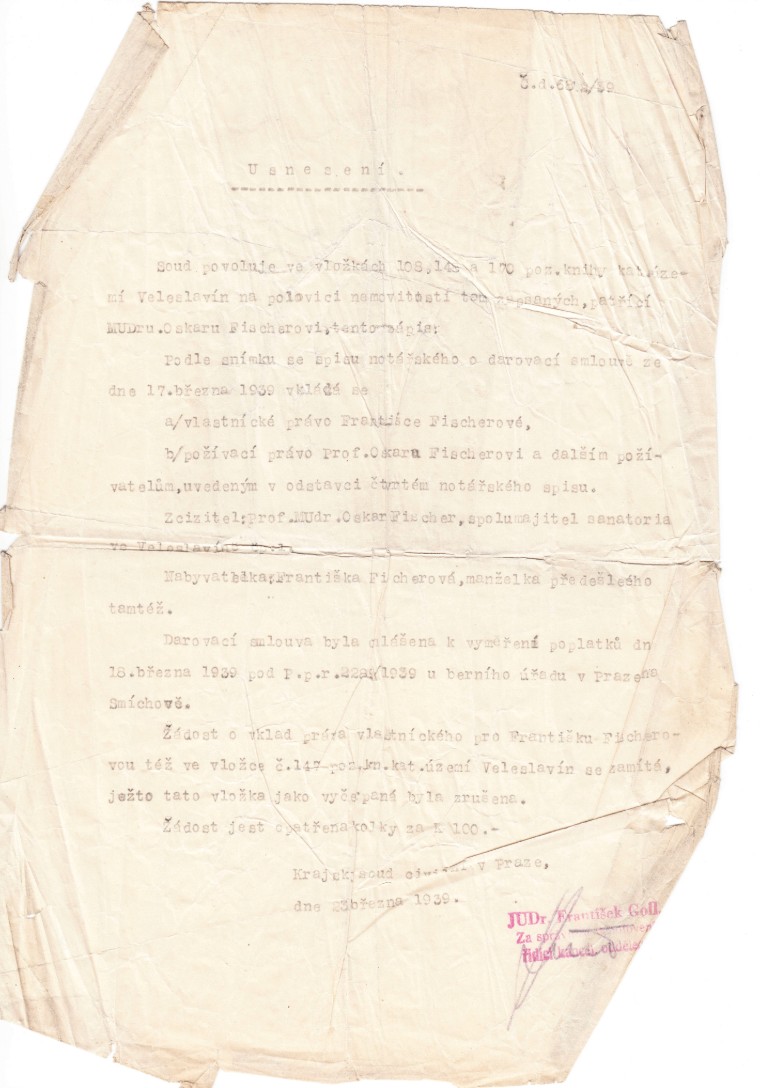
The document's real content is its date. Whatever Fischer understood about the Nuremberg framework before 15 March, he understood within forty-eight hours of the occupation exactly what was coming for a Jewish-owned institution, and he moved. The manoeuvre was not naïve — transfer to a non-Jewish spouse was among the few instruments the law of that moment appeared to leave open — and it was comprehensively defeated by an administration that was about to make such transfers retroactively worthless.
3.2 The Emigration Fund
The first transfer out of the family's hands was to an institution created for the purpose. On 19 November 1940, a portion of the estate passed to the Emigration Fund for Bohemia and Moravia (Auswanderungsfonds für Böhmen und Mähren), the body established to administer and dispose of Jewish property in the Protectorate.
The name is worth pausing on. An emigration fund is, on its face, an instrument for people who are leaving. What it administered was the property of people who were being removed, and in Fischer's case of a man who was not going anywhere except to a police prison forty kilometres up the Elbe.
3.3 Dr. Otto Knahl
The remainder passed in two contracts, on 5 June 1941 and 12 August 1941, to Dr. med. Otto Knahl. The instruments describe him as a "German of Aryan origin"; the racial status of the contracting parties is recited in the documents themselves, which is why the post-war courts had no difficulty finding them void on their face.
Knahl was not a physician looking for a clinic.
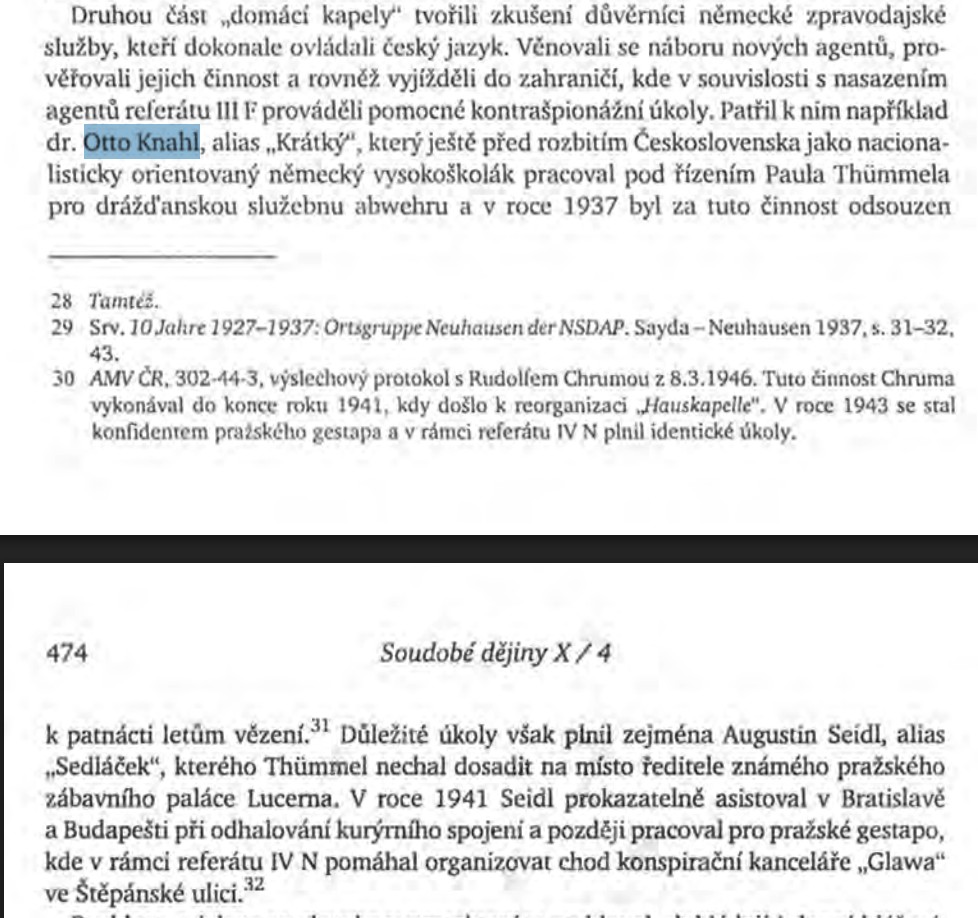
"Otto Knahl, alias 'Krátký', who, even before the breakup of Czechoslovakia, as a nationalistically oriented German university student, worked under the direction of Paul Thümmel for the Dresden Abwehr office, and in 1937 was sentenced to fifteen years in prison for this activity."
That is Stanislav Kokoška, writing in Soudobé dějiny, the journal of the Institute of Contemporary History of the Czech Academy of Sciences, in a study of Department III F of the Prague Abwehrstelle (Kokoška, 2003, pp. 473–474). Knahl was a convicted German intelligence agent, run by the double agent Paul Thümmel, serving a fifteen-year sentence in a Czechoslovak prison when the Germans arrived and freed him. Within two years he held the deed to Oskar Fischer's sanatorium.
It should be said precisely what this does and does not establish. It does not establish that Knahl was involved in Fischer's arrest, or that the sanatorium was stolen for him rather than assigned to him. Nothing in the family papers speaks to that, and this paper does not speculate about it. What it establishes is the character of the transaction: a hospital built by two Jewish physicians over thirty-one years was conveyed, under an administration that had freed him from prison, to a man convicted of espionage against the state that built it.
3.4 The Blocked Account
Fischer received nothing.
The approval document of February 1942 is explicit that the purchase price — 1,080,000 crowns — was not paid to the sellers but directed into special blocked accounts held in their own names, and it states the purpose to which those accounts were to be applied: the costs of the seller's transport to, and stay in, the concentration camp. A further compensatory levy of over 1.2 million crowns was payable directly to the treasury of the Reich Protector.
Two features of this deserve to be stated without ornament.
The transaction was structured to be self-financing. The state stole the asset, banked the price in the victim's name where he could not reach it, and drew down that balance to cover the cost of imprisoning him. The paperwork does not disguise this; it specifies it.
The levy exceeded the price. More money went to the Reich Protector's treasury as a levy than was nominally paid for the property itself. Whatever this was, it was not a sale in which a price was agreed and misapplied. The price was an accounting entry in an operation whose purpose was extraction.
3.5 The Refusal
Why Fischer was arrested is not inferred in this paper. It is reported by a man who was imprisoned with him and who wrote to his son about it four years later.
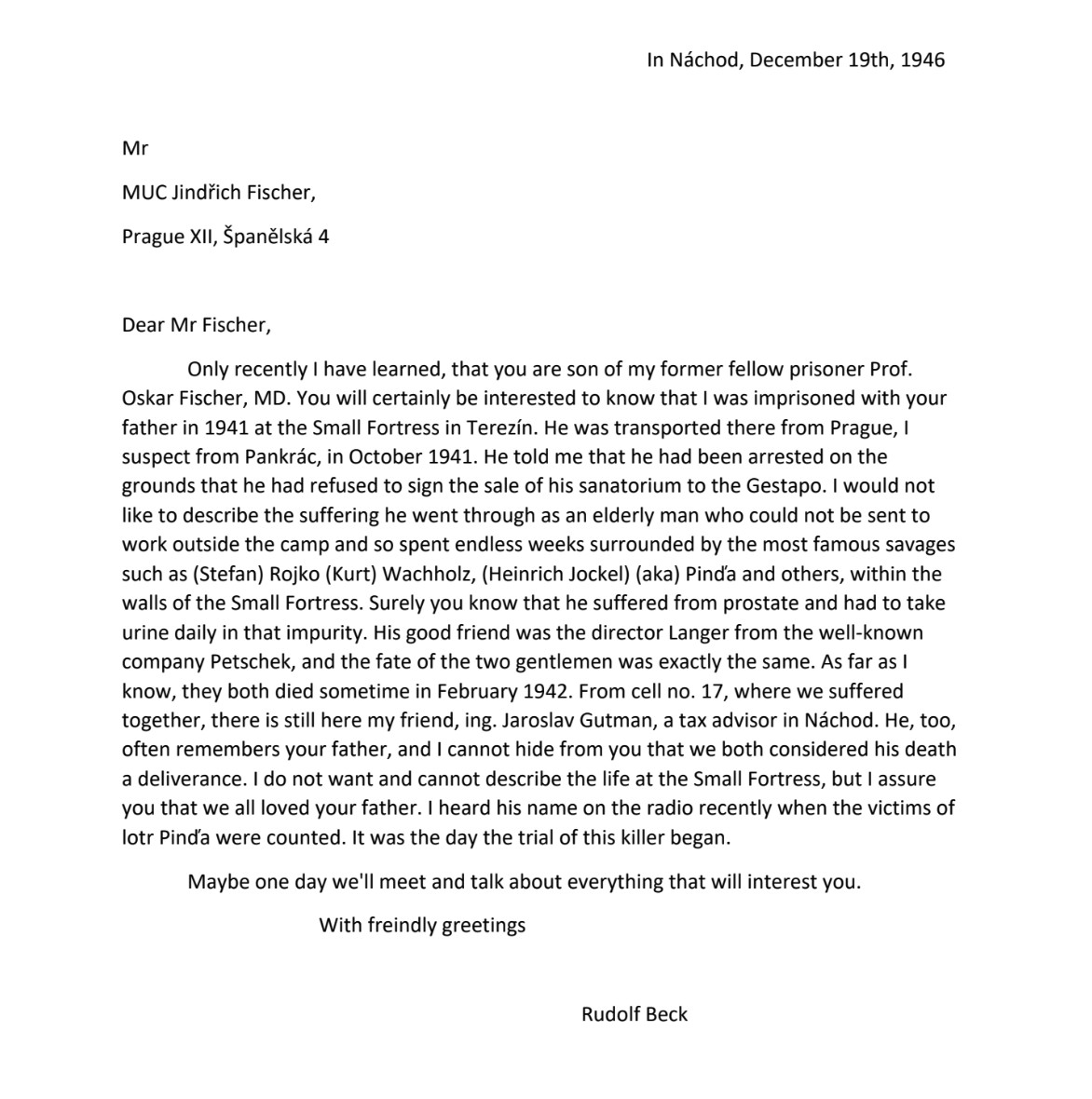
Beck states that he was held with Fischer at the Small Fortress in Terezín in 1941; that Fischer had been transported there from Prague — "I suspect from Pankrác" — in October 1941; and that
"He told me that he had been arrested on the grounds that he had refused to sign the sale of his sanatorium to the Gestapo."
That sentence reorganises the case. Fischer was not swept up in a general round-up of Jewish professionals, and he was not arrested for anything he had written or said. He was arrested for withholding a signature — and the signature was obtained anyway. The 2003 court record states that he signed purchase contracts in the concentration camp and others at the Petschek Palace, the Gestapo headquarters in Prague.
On the date of the arrest, the sources disagree, and this paper does not resolve it. A sworn declaration of 1969 places the arrest in the summer of 1941. The court finding records deportation on 1 July 1941. Beck places the transfer to the Small Fortress in October 1941. The reconstruction that accommodates all three is arrest and detention in Prague in the summer — after the forced sale of 5 June and around the second contract of 12 August — with transfer to Terezín in the autumn. That is a reconstruction and it is offered as one. Beck's own word for Pankrác is suspect, and his hedge is preserved rather than upgraded.
3.6 The Small Fortress
He was not sent to the Theresienstadt ghetto. He was sent to the Kleine Festung — the police prison of the Prague Gestapo, administered separately from the ghetto — and the evidence for that is in his own handwriting.
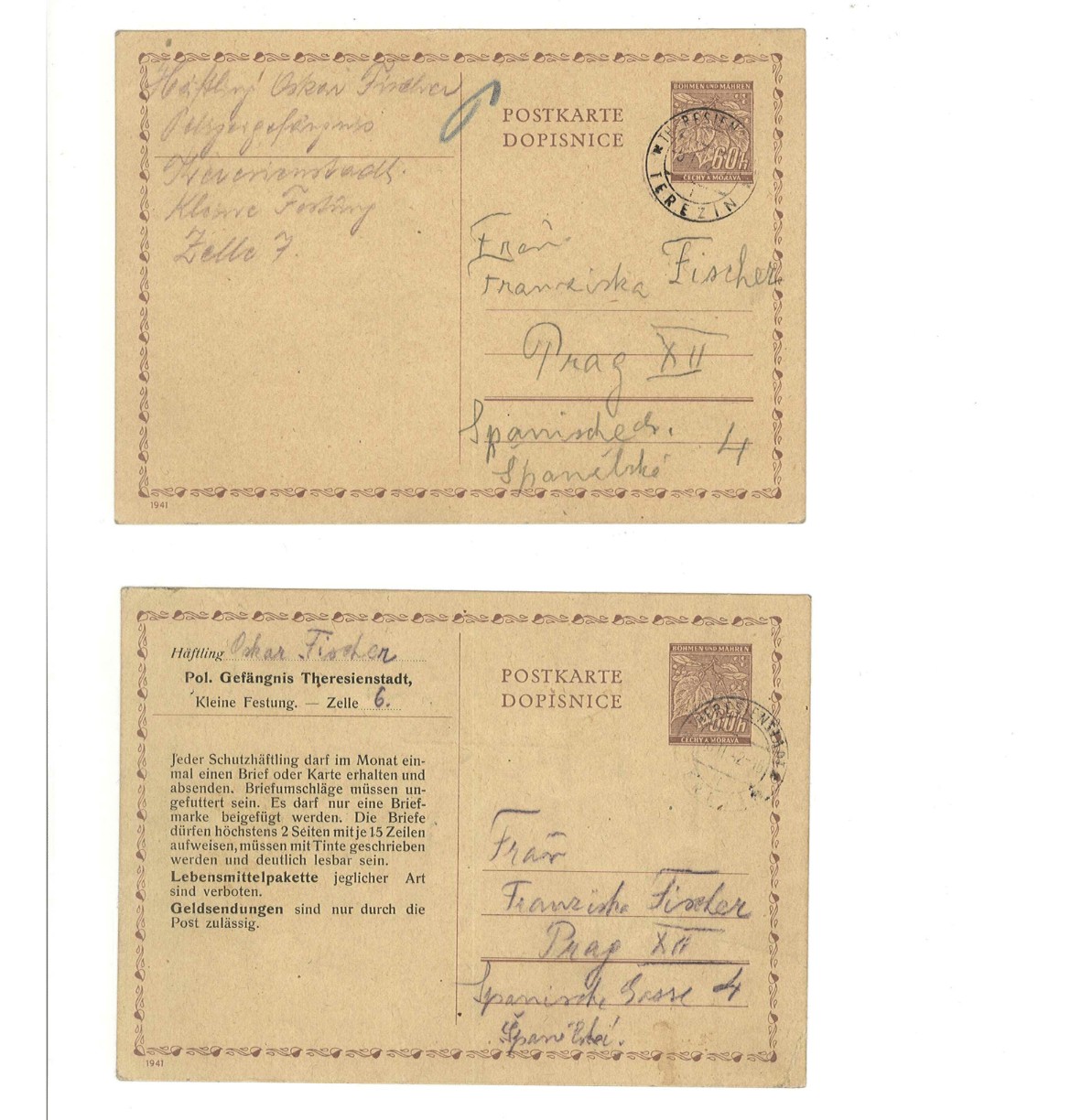
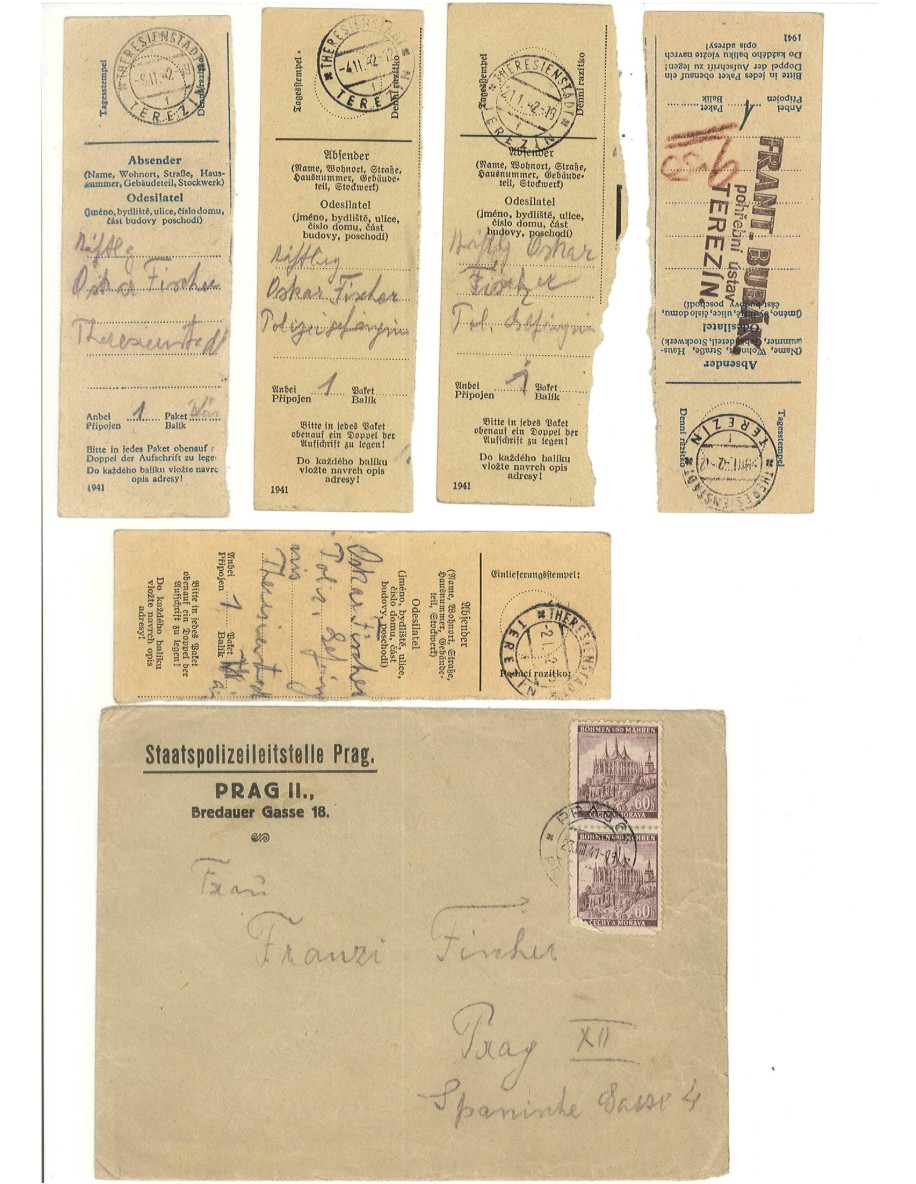
Two cell numbers, six and seven. One card a month. Fifteen lines to a page. And a printed rule forbidding food parcels of any kind — a rule the surviving counterfoils show the family testing anyway.
Beck's account of the conditions is given without rhetoric, and it is quoted here at the length he wrote it because paraphrase would improve it. Fischer, he says, was an elderly man who could not be sent to work outside the camp, and so spent "endless weeks surrounded by the most famous savages" — he names Rojko, Wachholz and Jöckel, the last known in the fortress as Pinďa — within the walls of the Small Fortress. He records that Fischer suffered from prostate disease and had to catheterise himself daily "in that impurity." Fischer's closest companion there was a director Langer of the Petschek company; both men died in February 1942. Beck, writing from cell 17, tells the son what he evidently believes the son needs to hear: "I do not want and cannot describe the life at the Small Fortress, but I assure you that we all loved your father." And of the death itself: "we both considered his death a deliverance."
He closes by explaining how the name had come back to him. He had heard it on the radio, when the victims of Jöckel were being counted, on the day that killer's trial began.
3.7 The Twenty-Third of February
On 23 February 1942, the Senior District Administrator issued the notice formally approving the "disposal of Jewish assets, de-Jewification of the sanatorium… in Veleslavín."
Fischer had five days to live.
There is no evidence that the two events were coordinated, and this paper does not suggest that they were. The sequence is stated because it is the sequence: the administrative process that converted the theft into good title completed itself while the man it was stolen from was still alive, and it completed itself first.
3.8 The Death
Oskar Fischer died at the Small Fortress on 28 February 1942, aged sixty-five. His wife was notified by 3 March.
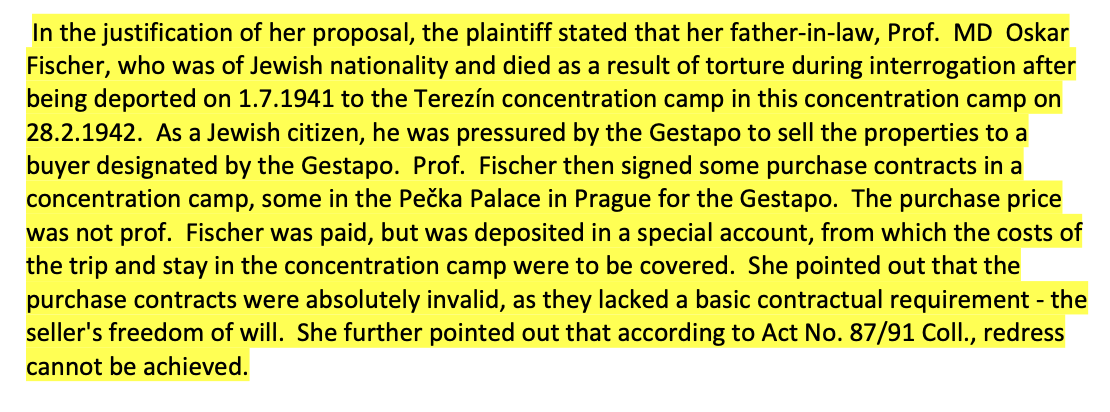
The cause is disputed between the standard published source and the family record, and this paper takes a side while saying that it is taking one. Goedert (2009), the review that returned Fischer's name to the modern scientific literature, reports that he died "apparently of a heart attack" — the hedge is Goedert's own. The family record says otherwise from three directions: the Czech court finding records death "as a result of torture during interrogation"; the witness who helped identify the body, alongside Fischer's son, recorded death from the consequences of Gestapo torture and noted the bruising to his face; and in 1969 the Ministry of National Defence certified him (certificate no. 107559/1969) as a participant in the national struggle for liberation and a Czechoslovak political prisoner martyred as a result of racial persecution.
We prefer the family record, and the reason is not that it is more dramatic. A heart attack is what a camp administration writes down. A contemporaneous eyewitness to the identification, a son who saw his father's face, a post-war court that examined the evidence, and a state certification of martyrdom are four instruments pointing the other way, and none of them had an interest in recording a beating that the administration had every interest in not recording.
Chapter IV. Limbo, 1945–1948
4.1 National Administration
The war ended and the property did not come back.
In November 1945 the Regional National Committee in Prague placed the Veleslavín sanatorium under state National Administration (národní správa). The reason was recorded on the face of the register: the property stood in the name of a German. That German was Otto Knahl.
The mechanism deserves to be seen clearly, because it recurs. The restored Czechoslovak state was confiscating German property, and the Veleslavín sanatorium was German property — as a direct and exclusive consequence of the Gestapo having made it so four years earlier. The instrument of the theft became the qualification for the sequestration. From the moment of liberation, the sanatorium's status in Czech law was determined by the last valid-looking entry the occupation had left behind.
4.2 The 1947 Filing and the Thirty-Year Lease
The surviving heirs — Dr. Viktor Kosák, son of Leo Kosák, together with Fischer's widow and children — filed for formal restitution in February 1947, under the framework of Act No. 128/1946 Coll., which existed precisely to invalidate transfers made under the pressure of occupation.
They were then informed of the condition attached. Even if the restitution succeeded and the property was returned, the state intended to subject it to a compulsory thirty-year lease, with a pre-emption right in the government's favour. They would own the sanatorium and would not be permitted to operate it until 1977.
4.3 What the Families Argued
Faced with that, the heirs drafted a proposed contract offering to sell the sanatorium to the Czechoslovak Ministry of Health outright for 14 million Kčs — expressly conditional on the restitution being granted first, so that they were selling something the state had acknowledged was theirs.
The arguments they made are worth recording, because they are the last time the two families speak in this history in their own voice about what the place was.
They argued that the lease would destroy their profession, not merely their income. The sanatorium had been founded on the premise that its founders and their families would practise in it; a thirty-year exclusion would end that.
They argued about the thirty years specifically. Locked out for three decades, they said, they would lose the connection to the work they had put into the institution over the thirty years since its founding, and by the time the lease ended there would be no practical way to take the enterprise up again. The symmetry is theirs: thirty years of building, thirty years of exclusion.
And they argued the state's own interest back to it. Outright ownership would give the government complete disposal of the property, allow permanent equipment to be installed for public medical care, and avoid the administrative complications of a long lease. The asking price, they noted, corresponded to an official state estimate — so the state would pay no more than under a future expropriation.
They also reminded the government, politely, that the statutory deadline for processing their restitution had already passed and that they could have gone to court, and offered the sale instead as a way of settling the matter permanently without a lawsuit.
It is a document written by people trying to be reasonable with an administration that had already decided. The offer was never taken.
Chapter V. Nationalisation, 1948–1989
5.1 Law No. 185/48
Before the 1947 restitution could be resolved, the political landscape changed underneath it. The communist coup of February 1948 was followed by Law No. 185/48, mandating the merger and nationalisation of medical institutions. A private sanatorium was now, as a category, something the state absorbed.
The restitution claim did not become wrong. It became irrelevant.
5.2 January 1951: Persecution Acknowledged, Compensation Discretionary
In January 1951 the courts formally ended the restitution proceedings. The finding is the first of three occasions on which a Czechoslovak or Czech court states the history accurately and declines to act on it: the court acknowledged that Fischer had lost the property as a result of racial and political persecution, and held that any compensation was a matter for the discretion of the Ministry of Health.
Acknowledgement without remedy is the pattern of this entire chapter of the history, and 1951 is where it is first set down in a judgment.
5.3 17 October 1952
On 17 October 1952 the Czechoslovak state, through the Ministry of Health, deleted the National Administration status and registered the ownership rights of the Veleslavín property to itself.
That date matters more than it looks, and it will return in Chapter VI. It is the date from which the modern courts would later measure the state's possession — and possession, held long enough and in the right frame of mind, becomes title.
Chapter VI. The Modern Court, 1990s–2005
6.1 Hana Fischerová's Claim
After 1989, Hana Fischerová, Fischer's daughter-in-law, brought proceedings to have the purchase contracts of 19 November 1940, 5 June 1941 and 12 August 1941 declared legally invalid. Her husband, as Fischer's heir, would have had the right to inherit the property; she claimed as his successor.
6.2 What the Courts Conceded
The remarkable feature of the judgments is how much they grant.
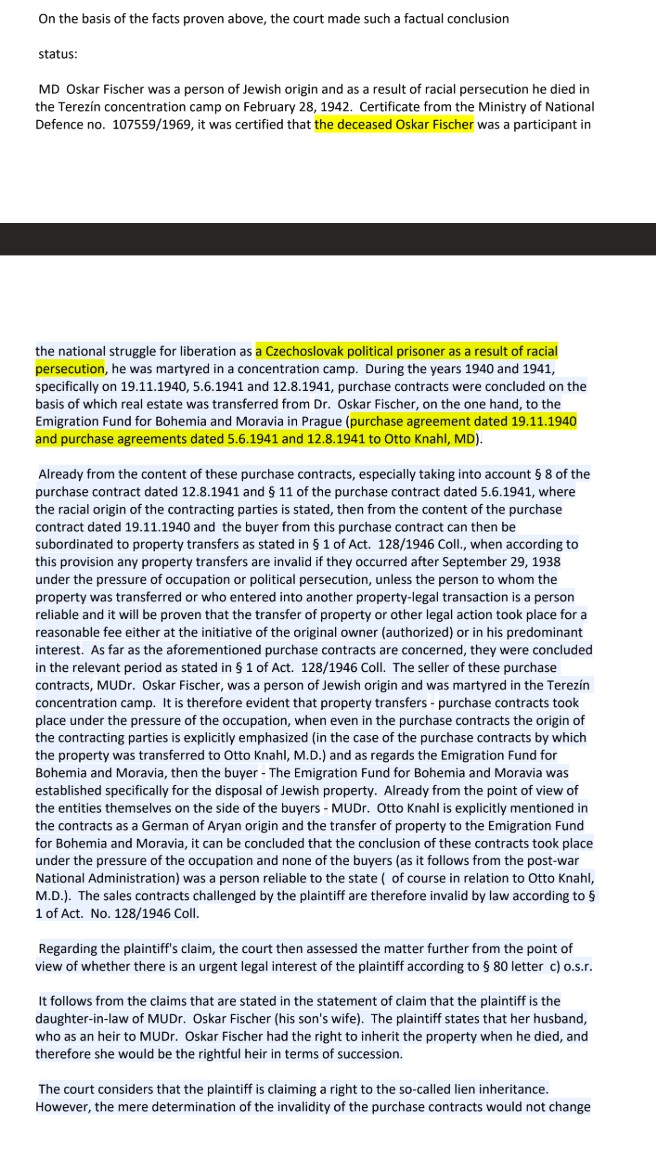
The court found that the transfers fell squarely within § 1 of Act No. 128/1946 Coll. — under which property transfers made after 29 September 1938 under the pressure of occupation or political persecution are invalid, unless the transferee was a reliable person and the transfer took place for reasonable consideration at the original owner's initiative or in his predominant interest. It observed that the contracts themselves recite the racial origin of the contracting parties; that the Emigration Fund for Bohemia and Moravia existed specifically to dispose of Jewish property; that Knahl is described in the instruments as a "German of Aryan origin"; and that neither buyer was a person reliable to the state. It concluded that the sales contracts are invalid by law.
It further found that Fischer was pressured by the Gestapo to sell to a buyer the Gestapo designated, that he signed some contracts inside a concentration camp and others at the Petschek Palace, that the purchase price was never paid to him but deposited in a special account from which the costs of his imprisonment were to be covered, and — in the plaintiff's characterisation, recorded by the court — that the contracts were absolutely invalid for want of the seller's freedom of will.
On the history, in other words, the family won completely.
6.3 Urgent Legal Interest
They lost on standing.
Czech civil procedure requires a plaintiff seeking a declaration that a past contract was invalid to show an urgent legal interest in the declaration. The appellate court held that Hana Fischerová had none: declaring the 1940 and 1941 contracts invalid would not, by itself, return the property to Fischer's estate or alter her legal position, and courts do not issue declarations that produce no remedy.
The reasoning is orthodox and, taken in isolation, unremarkable. Its effect here is that the more comprehensively the court agreed the property had been stolen, the more clearly it could observe that saying so would change nothing.
6.4 The Three-Year Window
The second ground was limitation. Act No. 128/1946 Coll. — the very instrument that made the contracts void — required victims or their heirs to assert claims under it within three years of the law taking effect. The Fischer family's post-war claim did not successfully navigate that window; the 1947 filing ran into the compulsory-lease condition, the 1948 nationalisation, and the 1951 closure.
The claim was therefore time-barred: extinguished by the deadline attached to the remedy that would otherwise have applied.
6.5 Good Faith
The third ground is the one that gives this paper its title.
The district court held that even if the contracts were invalid, the Czechoslovak state had acquired the property by adverse possession: it took ownership in 1952 and held it for the required ten-year retention period in good faith, thereby acquiring title before the law changed in 1964.
The difficulty is a matter of record rather than of sentiment. The state had placed the sanatorium under National Administration in November 1945 because it stood in the name of a German — that German being a convicted Abwehr agent whose title derived from contracts executed by a man in a Gestapo prison. The state was not a stranger to the property's history; the property's history was the reason the state had it. Whatever the doctrine of good-faith possession is designed to protect, a possessor who knows precisely how the previous holder acquired the thing is an awkward fit for it.
This paper does not assert that the finding was legally wrong; that is a question for Czech property lawyers, and §7.2 declines to pretend otherwise. It records that the finding was made, that it rests on a characterisation of the state's knowledge, and that the documents bearing on that knowledge are the ones reproduced here.
6.6 The 2005 Dismissal
In 2005 the appellate court dismissed the claim for want of urgent legal interest, and the chain that began with the Gestapo in 1940 was closed by a court of the Czech Republic sixty-five years later.
Chapter VII. What the Record Establishes
7.1 The Question in the Title
Who killed Oskar Fischer and his science? The question contains an assumption worth making explicit: that the two events belong together. This paper's answer is that they do — not as cause and effect, but as the same thing happening twice to the same man.
His science was stolen in 1910, and nobody killed it. A textbook editor in the dominant school named a disease after a colleague in his own institute. That was lawful, ordinary, and within his gift. What followed was displacement rather than destruction: the framework was not refuted, it was made invisible by a vocabulary that pointed elsewhere, and a field trained inside the new vocabulary could no longer see the old one. Nobody intended it and no one is culpable. It was recovered, partially, when people went back and read the 1910 monograph — which is what happens to a thing that was displaced rather than destroyed.
His institution was stolen in 1941, and that was a crime with named participants. He was arrested for refusing to sign it away. The price was paid into an account from which his own imprisonment was funded. He died of injuries sustained under interrogation, five days after the transfer was approved. The property has never come back, and the reason it has not is that three states in succession declined to return it.
What joins them is not a chain of causation but a pattern of hands. Twice, Fischer built something substantial. Twice, it was stolen intact — not smashed, not disproved, but lifted whole and re-attributed to someone better placed to hold it. Twice, the instrument was paperwork rather than force: a textbook entry and a purchase contract. And twice, the record of who had made the thing was allowed to go quiet, in the first case by inattention and in the second by design.
That pattern is worth naming and it is not worth over-reading. It does not mean the scientific establishment was complicit in his death; it was not, and §7.2 says so at length. It does not mean the eponym was a crime; it was not. It means that the same man, twice in one lifetime, made something that was stolen from him and given another name — and that the second time, the theft killed him.
Anyone who wants only the defensible half can have it: the sanatorium file alone would carry this paper. The doubling is offered because it is true, because Fischer is the person it happened to twice, and because a history that reports only the crime leaves out the thing that makes the crime legible — that by 1939 Fischer was already a man whose principal work bore another man's name, and nobody was looking.
7.2 What This Is Not Evidence Of
Four disclaimers, stated before the conclusion rather than after it, because a paper assembled from documents this vivid should say what it is not claiming while the reader still has the energy to hold it against the rest.
It is not evidence that Fischer was killed for his science. Nothing in the record connects the 1910 eponym to the 1941 arrest. The Munich school had no part in what happened at Veleslavín, and the causal chain that ends in the Small Fortress begins with a valuable building and a racial law, not with a disputed priority. The two erasures share a shape — something Fischer made was stolen intact and re-attributed — and share nothing else. A paper that blurred them would forfeit the right to be believed about either.
It is not evidence that Otto Knahl participated in the arrest. Knahl's conviction as an Abwehr agent is established by an independent academic source. His role in the transaction is established by the contracts. Whether he sought the property, was assigned it, or had any knowledge of how the signature was obtained is not addressed by any document available here, and this paper does not speculate.
It is not a legal opinion on the Czech judgments. Whether the good-faith finding was correct under Czech property law, and whether the limitation ruling was properly applied, are questions for lawyers in that jurisdiction. What is offered is the documentary record the judgments were reasoning about.
And it is not a restitution claim. No remedy is sought here and none is proposed. The family's litigation concluded in 2005.
7.3 What It Is Evidence Of
What remains, when all of that is set aside, is still considerable, and it is fully papered.
A hospital was stolen by a procedure that recorded its own logic. The contracts recite the racial status of the parties. The approving notice describes its purpose as de-Jewification. The buying institution was named for emigration and existed for confiscation. None of this was inferred by later historians; it is what the instruments say about themselves.
The victim was made to fund his own imprisonment. The purchase price went to a blocked account in his name, and the account was to pay for his transport to and stay in the camp. This is the single fact in the record that most resists paraphrase, and it is documentary.
He was arrested for withholding a signature, and the signature was taken anyway — some contracts executed in a concentration camp, others at Gestapo headquarters in Prague.
The administrative approval of the theft completed five days before he died.
And three successive states each looked at this and declined to undo it — not by denying the history, which each of them accepted in terms, but by finding that the history had been recorded too late, or that saying so would achieve nothing, or that the state's own possession had ripened into title in good faith. The 1951 court acknowledged racial and political persecution and left compensation to a ministry. The 2003 court found the contracts invalid by law. The 2005 court dismissed for want of urgent legal interest.
The pattern across sixty-six years is not denial. It is acknowledgement without remedy, and that is a different and more durable thing.
7.4 The Unresolved Points
Four, stated plainly so that a later edition can close them.
The date of the arrest. Summer 1941 (sworn declaration, 1969), 1 July 1941 (court finding), October 1941 for the transfer to Terezín (Beck). The reconstruction in §3.5 fits all three and is a reconstruction.
The parcel counterfoils. The postmark years are not legible with confidence. If any of them postdates 28 February 1942, that is a fact of some weight about what the family knew and when, and it is not claimed here.
The archival locations and case numbers. The originals are held by the family; the judgments have case numbers. Neither is recorded in this edition. A reader who needs them should ask.
The fate of Leo Kosák. He is present in this history at its founding and his son appears among the post-war heirs. What happened to him between 1939 and 1945 is not addressed by the documents used here, and it is a gap this paper is conscious of rather than one it can fill.
7.5 Conclusion: In Good Faith
The phrase belongs to the district court, which used it to describe the Czechoslovak state's possession of a sanatorium it had acquired because the sanatorium stood in the name of a convicted German agent, who held it because a physician had been imprisoned until he signed.
It is worth resisting the easy reading. The court was not being cynical; it was applying a doctrine that exists for good reasons, to a fact pattern that the doctrine was not built for. Statutes of limitation give property finality. Declaratory relief is refused where it would change nothing. Long possession ripens into title. Each rule is defensible and the three together were dispositive.
That is the thing this record actually documents, and it is less lurid and more useful than a conspiracy would have been. The theft required a regime. Keeping it required only ordinary law, applied conscientiously, three times over. No official after 1945 had to deny that Oskar Fischer was persecuted, made to sign under duress, or martyred at Terezín. Every one of them conceded it. The concession simply never had anywhere to attach.
And it is the second time the same thing was done to the same man.
In 1910 a textbook gave the disease he had described the name of somebody better placed to hold it. Nothing was destroyed; the monograph stayed on the shelf, and anyone could have taken it down. Almost nobody did, and within a decade the framework had gone out of the literature — not refuted, just unreadable, because the field had been trained in a vocabulary that pointed away from it.
In 1941 a contract gave the hospital he had built to somebody better placed to hold it. Nothing was destroyed there either; the sanatorium is still standing at Veleslavín. What was removed was the name on the deed, and then the man.
The mechanisms could hardly be less alike — one lawful and unintended, the other criminal and deliberate, separated by thirty-one years and by any chain of causation you care to look for. But the outcome has the same shape both times, and it is worth saying in one sentence: twice Oskar Fischer made something substantial, twice it was lifted whole and re-attributed, and twice the record of who made it was allowed to go quiet. The first time, it cost him the credit. The second time, it cost him his life.
Of the two, only one has been partly undone. His science came back because the 1910 monograph survived and could be read again, which is what happens to a thing that was displaced rather than destroyed. The sanatorium has not come back, and will not.
The documents are reproduced above. They were kept by a family for eighty-four years, which is the only reason any of this can be said at all — and it is the same reason the science could be recovered. Somebody kept the paper.
Documents
Reproduced in this paper, from the Fischer family papers, published with the family's permission:
- Deed of donation, Prague-Smíchov, 17 March 1939 — Oskar Fischer to Františka Fischerová, half share of the Veleslavín properties (land registers 108, 147, 148, 170), reserving a life usufruct. Registered for fee assessment 18 March 1939.
- Ministry of Social and Health Administration, 1 February 1941 — parallel Czech and German replies to Fischer's enquiry of 27 January 1941 regarding authorisation to practise at the Prague-Veleslavín sanatorium.
- Two postcards from Oskar Fischer, Polizeigefängnis Theresienstadt, Kleine Festung, cells 7 and 6, to Františka Fischer, Prague XII, Španělská 4.
- Five parcel counterfoils stamped Theresienstadt/Terezín in Fischer's name as Häftling, one bearing the imprint of a Terezín funeral establishment; and an envelope of the Staatspolizeileitstelle Prag, Bredauer Gasse 18.
- Letter of Rudolf Beck to MUC Jindřich Fischer, Náchod, 19 December 1946 — reproduced as a typed translation, not a facsimile.
- Translated findings of the Czech courts, 2003 and 2005, including the recital of the contracts of 19.11.1940, 5.6.1941 and 12.8.1941, the finding of invalidity under Act No. 128/1946 Coll., and the dismissal for want of urgent legal interest.
Not reproduced, but relied on and described in the text: the sworn declaration of 1969 identifying the body; the certificate of the Ministry of National Defence no. 107559/1969; the notice of the Senior District Administrator of 23 February 1942 approving the de-Jewification of the sanatorium; and the 1947 draft contract offering the sanatorium to the Ministry of Health.
References
Fischer, O. (1907). Miliare Nekrosen mit drusigen Wucherungen der Neurofibrillen, eine regelmässige Veränderung der Hirnrinde bei seniler Demenz. Monatsschrift für Psychiatrie und Neurologie, 22, 361–372. Find this paper
Fischer family papers. Notary donation contract, Prague-Smíchov, 17 March 1939; correspondence of the Ministry of Social and Health Administration, 1 February 1941; prison postcards of Oskar Fischer, Polizeigefängnis Theresienstadt–Kleine Festung, cells 6 and 7; parcel counterfoils, Terezín; letter of Rudolf Beck to Jindřich Fischer, Náchod, 19 December 1946; sworn declaration, 1969; certificate of the Ministry of National Defence no. 107559/1969; translated findings of the Czech district and appellate courts, 2003 and 2005. Previously unpublished; reproduced by permission of the family.
Goedert, M. (2009). Oskar Fischer and the study of dementia. Brain, 132(4), 1102–1111. Find this paper
Gustafsson, B. A. (2026). Fischer's Sidelining: A Biographical–Intellectual History. ONS Methodology, AdultCognitiveDisease.com. (The companion study of the scientific eclipse. The present paper deliberately does not repeat its argument; see §7.1.) Find this paper
Kokoška, S. (2003). Německá vojenská kontrašpionáž v Praze: Referát III F Abwehrstelle Prag a jeho činnost proti spojeneckým zpravodajským službám [German military counterintelligence in Prague: Department III F of Abwehrstelle Prag and its operations against Allied intelligence services]. Soudobé dějiny, 10(4), 454–480 (Knahl at 473–474). Prague: Institute of Contemporary History, Czech Academy of Sciences. Find this paper
Act No. 128/1946 Coll., on the invalidity of certain property transactions from the period of unfreedom and on claims arising from that invalidity (Czechoslovakia).
Law No. 185/1948 Coll., on the nationalisation of medical institutions (Czechoslovakia).
— End of paper —